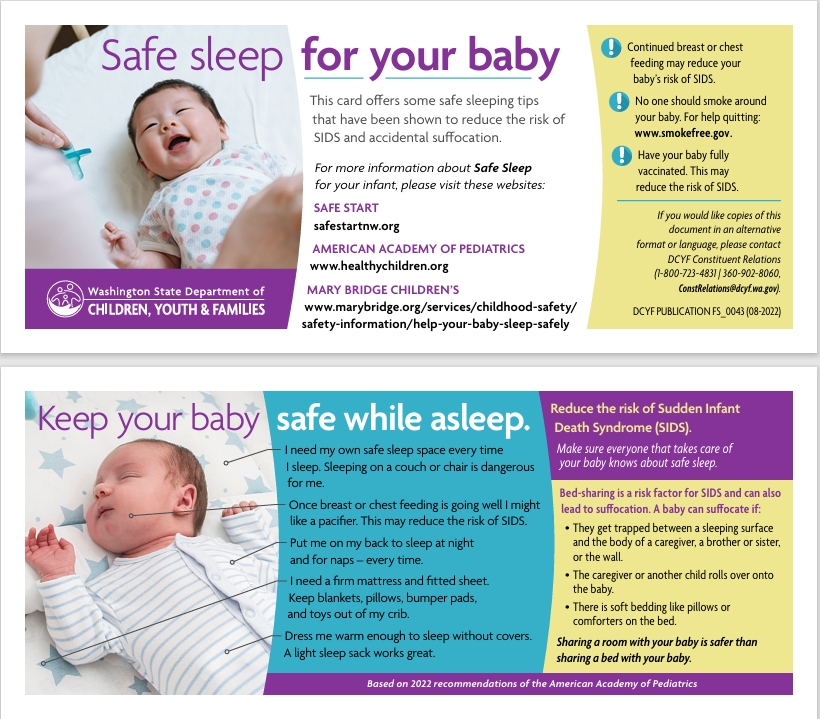

In 2009, Representative Mary Helen Roberts championed the need for all parents to receive new and expanded information to keep infants safe while they are sleeping.
Parent Trust for Washington Children co-chairs the Infant Safe Sleep Coalition to ensure that all parents of infants receive critical new information provided by the American Academy of Pediatrics to prevent Sudden Infant Death Syndrome (SIDS) and Sudden Unexpected Infant Death (SUID) due to unsafe sleep environment.
The following information is provided by Mary Bridge Children’s >>
Tips for Safe Sleep
Place baby on their back every time they sleep. This includes naps and at nighttime
Use a firm, flat, non-inclined sleep surface — Examples include a crib, bassinet or Pack ’n Play with just a tightly fitted sheet. Do not allow baby to sleep on an adult bed, couch, swing or inclined sitting device. If they fall asleep in their car seat during travel, take them out as soon as you arrive.
Keep soft objects away from baby’s sleep area. Remove loose bedding, bumpers, pillows, pillow-like toys, quilts, comforters, mattress toppers, fur-like materials and other similar items.
Room-share, but don’t bed-share. Keep baby’s crib or bassinet in their parents’ room for at least the first six months. But bringing them into your bed is not recommended under any circumstances as it significantly increases baby’s risk of dying from SIDS or suffocation.
Dress baby in layers for warmth. Aim for one more layer than you need at that temperature — a wearable blanket, sleep sack or pajamas serves as a good top layer. Leave off the hat, as it can cause them to become too hot. If baby is sweating, their skin is flushed or their chest feels hot, remove layers so they can cool down, as overheating is a risk factor for SIDS. Do not use weighted sleep sacks.
If you choose to swaddle, do it safely. Swaddle only to shoulder level, snug at the chest but loose at the hips. Stop swaddling when baby shows signs they are ready to roll over from back to tummy (likely by 2-3 months).
Offer a pacifier while baby is falling asleep. Breastfeeding babies can wait until they are fully accustomed to nursing before introducing a pacifier (usually by 3-4 weeks).
Breastfeed for as long as possible. Human milk reduces the risk of SIDS and many other health problems.
Supervised awake “tummy time” is important to strengthen their upper body and minimize flattening on the back of the head. Begin soon after hospital discharge and incrementally work up to 15-30 minutes total per day by the time the baby is 7 weeks.
Attend all of your prenatal care visits.
Keep your child’s immunizations up to date. Recent studies show that immunizations have a protective effect against SIDS, in addition to preventing infectious disease.
Avoid smoke and nicotine exposure (including vaping) during and after pregnancy. For help quitting, go to smokefree.gov.
Avoid alcohol, marijuana, opioids and illicit drug use during and after pregnancy.
Avoid devices marketed to reduce SIDS. This includes wedges, positioners, special sleep surfaces and home cardiorespiratory monitors. There is no evidence that they are safe or effective.
Request a Safe Sleep Card
Contact our Family Help Line to request free Safe Sleep cards while supplies last.
1-800-932-4673